







- Indian Mythology - Stories of the Gods & Heroes
- Long before people spoke about climate change, pollution, or protecting nature, Indian mythology had already imagined Earth as a living mother - kind, patient, and endlessly giving. That mother was Prithvi Devi, the goddess of Earth. Her stories are filled with courage, wisdom, love, and an important message for today's children: take care of the world that takes care of you.
In Hindu mythology, Prithvi Devi is the goddess of Earth. She is also called Bhumi Devi, Dharti Maa, or simply Mother Earth.
The word "Prithvi" means Earth. Ancient Indians believed the Earth was not just soil, rocks, and rivers. They believed it was a living, divine mother who feeds all creatures, protects life, and patiently carries everyone - humans, animals, forests, mountains, and oceans.
Think about it: every fruit, vegetable, flower, tree, and grain of rice grows because of Earth. Without Earth, no life would exist. That is why Prithvi Devi was worshipped with deep respect.
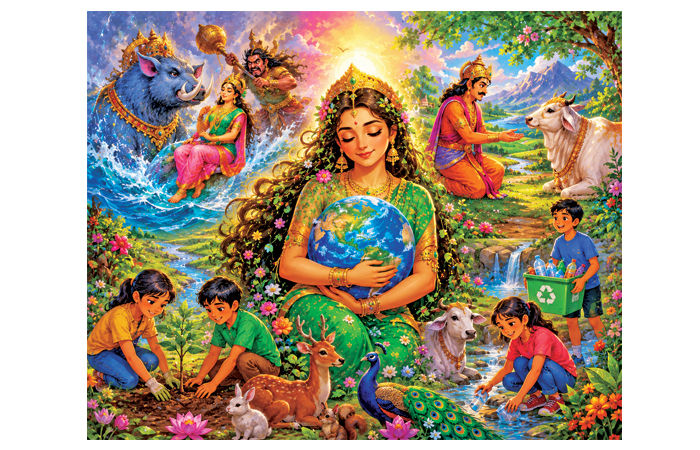
In old stories, she is usually shown as a beautiful goddess wearing green or red clothes, often seated on a lotus or surrounded by plants and animals. Sometimes she is shown with cows because cows were symbols of nourishment and motherhood.
But Prithvi Devi was not only gentle and loving. She was also strong, wise, and patient.
And one of her most famous stories is truly dramatic.
The Story of Prithvi Devi and the Demon Hiranyaksha
Long ago, according to mythology, a powerful demon named Hiranyaksha became arrogant and dangerous. He wanted to prove that nobody in the universe was stronger than him.
So what did he do?
He attacked the Earth itself.
The demon dragged Earth deep into the cosmic ocean. Suddenly, everything became dark and chaotic. Mountains disappeared underwater. Life was in danger. The gods became frightened because without Earth, the balance of the universe would collapse.
The gods rushed to Vishnu for help. Vishnu decided to save Prithvi Devi by taking a special form - the form of a giant wild boar called Varaha.
This form is known as the Varaha avatar.
Now imagine the scene.
A gigantic divine boar rises from the cosmic waters with thunder-like roars. His body shines like a mountain. His tusks are huge and powerful. The oceans shake as he dives into the deep darkness searching for Earth.
Finally, Varaha finds Prithvi Devi trapped underwater. He lifts her gently on his tusks and brings her safely upward. But Hiranyaksha attacks him fiercely. A massive battle takes place between Varaha and the demon.
The fight continues for a long time. The sky trembles. Oceans roar. Gods watch nervously.
At last, Varaha defeats Hiranyaksha and saves the Earth.
Prithvi Devi is restored to her rightful place, and life begins again peacefully.
This story is one of the most famous myths connected to Earth in Indian mythology. It symbolises hope, protection, and the victory of balance over destruction.
Prithvi Devi and King Prithu
Another important story explains why Earth is called "Prithvi."
Long ago there was a wise king named Prithu. During his time, people suffered because crops stopped growing. Food became scarce. Rivers dried up. Everyone was hungry.
The king discovered that Earth had stopped giving her riches because humans had become greedy and irresponsible. They were taking too much and respecting nature too little.
Prithvi Devi took the form of a cow and ran away. King Prithu chased her, asking why she refused to nourish the world.
Finally, Earth explained her sadness:
"If humans misuse nature and behave selfishly, why should I continue giving endlessly?"
King Prithu promised to protect nature and use Earth's resources wisely. Only then did Prithvi Devi agree to nourish humanity again. Crops grew, rivers flowed, and peace returned.
According to mythology, Earth became known as "Prithvi" because of King Prithu.
This story feels surprisingly modern today, doesn't it?
Why Prithvi Devi Still Matters Today
Thousands of years ago, these stories may have sounded magical and symbolic. But today they feel incredibly relevant.
The Earth is facing pollution, climate change, disappearing forests, and environmental damage. In a way, modern humans have become a little like the greedy people from old myths - taking too much and giving too little back.
Prithvi Devi's stories remind us that Earth is not an endless machine. It is something precious and alive.
And maybe that is why ancient people called Earth a mother - because mothers keep giving even when humans forget to say thank you.
So the next time you walk barefoot on grass, eat a mango, smell flowers after rain, or watch a sunset, remember: according to mythology, all these gifts come from the loving patience of Prithvi Devi, the godd.
- What Children Today Should Learn from Prithvi Devi
1. Nature Is Not a Dustbin
Prithvi Devi teaches us that Earth is sacred. Today people throw plastic everywhere, waste water, cut forests, and pollute rivers carelessly.
Imagine how sad Mother Earth would feel!
Children should learn that protecting nature is not only the government's job. Small actions matter too:
saving water,
avoiding littering,
planting trees,
reducing waste,
caring for animals.
Every small act is a way of respecting Prithvi Devi.
2. Patience Is a Superpower
Earth quietly tolerates so much - storms, digging, pollution, noise, wars, and endless human activity. Yet it still gives us food, rain, flowers, and beauty.
Prithvi Devi represents patience and calm strength.
Today's children live in a fast world where everyone wants instant results. But good things often grow slowly - like trees, friendships, skills, and confidence.
3. Balance Matters
The story of King Prithu teaches balance. Humans should use nature wisely, not greedily.
This lesson also applies to daily life:
study, but also rest,
use technology, but also play outside,
dream big, but stay kind.
Balance creates happiness.
4. Kindness Is Strength
Prithvi Devi is nurturing and gentle, but she is not weak. Many people think kindness means softness or helplessness. Mythology shows otherwise.
Real strength can also be calm, caring, and patient.
- Fun Facts About Shabari
1. She Is One of the Oldest Goddesses in Indian Mythology
Prithvi Devi is mentioned in the ancient Rigveda, one of the world's oldest sacred texts.
2. She Is Sometimes Called Bhumi Devi
In South India especially, people often call her Bhumi Devi. Temples dedicated to her still exist today.
3. Varaha Temples Are Connected to Her Story
Many temples of Vishnu's Varaha avatar show him lifting Earth goddess Prithvi Devi on his tusks.
4. Farmers Traditionally Respect Earth Before Farming
In many Indian traditions, farmers touch the soil respectfully before ploughing fields because Earth is seen as divine.
5. Even Today People Call Earth "Mother Earth"
Interestingly, many cultures around the world imagine Earth as a mother figure - not only Indian mythology.