







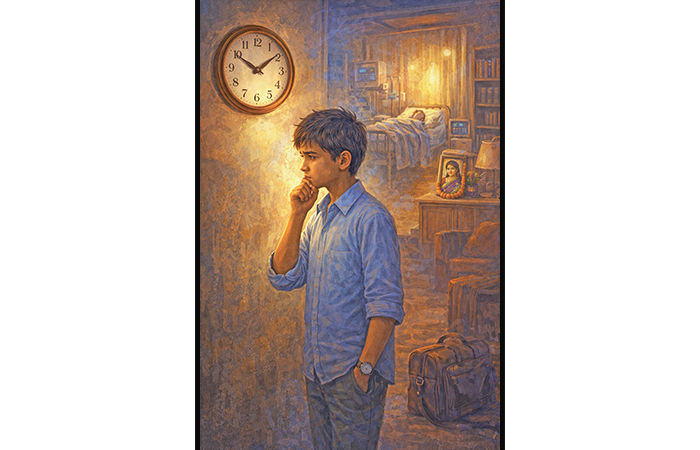
- The house felt different. Too quiet. The wall clock read 8:05. His mother's room was empty.
- Rohan paused. He no longer rushed. He did not look at his phone. He simply stood still for a moment.
- Rohan wished time would go backwards instead of forward. He wanted those lost moments back-those five minutes he never gave.
Vaidik Boda
T he wall clock in Rohan's house was always five minutes fast.
No one quite remembered why. The reason had faded with time, as if it had quietly slipped away from memory. People simply accepted it. The clock remained five minutes ahead-always.
Every morning, Rohan would glance at the clock while tying his shoelaces. It would read 8:05. Panic would immediately set in. He would rush out of the house, barely making it to school on time. This became a routine-Rohan and the clock, always racing against those five extra minutes.
Once, his father had suggested fixing it. "It should be repaired," he had said, thinking it was a simple problem with a simple solution.
But his mother disagreed. She smiled and said, "Let it be. It keeps him active. It's good for him."
And so, the clock remained unchanged. Time moved on-quietly, swiftly. One day Rohan was in school, the next he was in college, and before he knew it, he had started working. Life kept moving forward, but that clock in his house always stayed five minutes ahead of the world.
Getting his job was a big moment for Rohan. But soon after, something unsettling happened-his mother fell ill.
She brushed it off lightly. "I'm just tired," she would say from her bed. "It's nothing."
But Rohan could see that it was not nothing.
One morning, as he stood beside her, worry crept into his mind. He glanced at his watch. He was already running late. Anxiety took over.
"I'll talk to you properly in the evening," he said hurriedly, picking up his bag.
Evenings came and went. Deadlines replaced dinners. Conversations grew shorter. "Kal baat karte hain," became a habit - a promise postponed, again and again.
One night, Rohan came home unusually early.
The house felt different. Too quiet.
The wall clock read 8:05.
His mother's room was empty.
At the hospital, time slowed down painfully. Each second felt heavy, each minute louder than the last. The doctor spoke softly, but Rohan could barely hear him.
"She was waiting for you," the doctor said gently. "She kept asking what time you would come."
Rohan sat on a bench, staring at his watch. For the first time, he wished time would go backwards instead of forward. He wanted those lost moments back-those five minutes he never gave.
A few days later, after all the rituals were over, Rohan looked at the wall clock again.
It had stopped.
Exactly at 8:05.
No one had fixed it.
And now, it never would be.
From that day on, every morning before leaving for work, Rohan paused. He no longer rushed. He did not look at his phone. He simply stood still for a moment.
He looked at the silent clock.
And remembered what five minutes could mean.
Sometimes, five minutes can change everything.
Slowly, Rohan began leaving earlier. He started sitting longer at home. Talking more. Listening more.
Time did not slow down.
But Rohan did.
Moral
Time never stops for us-but we can choose how we use it, and who we give it to.